

The Philippines desperately needs Constitutional Reform!
The 1987 Constitution of the Philippines is Flawed…
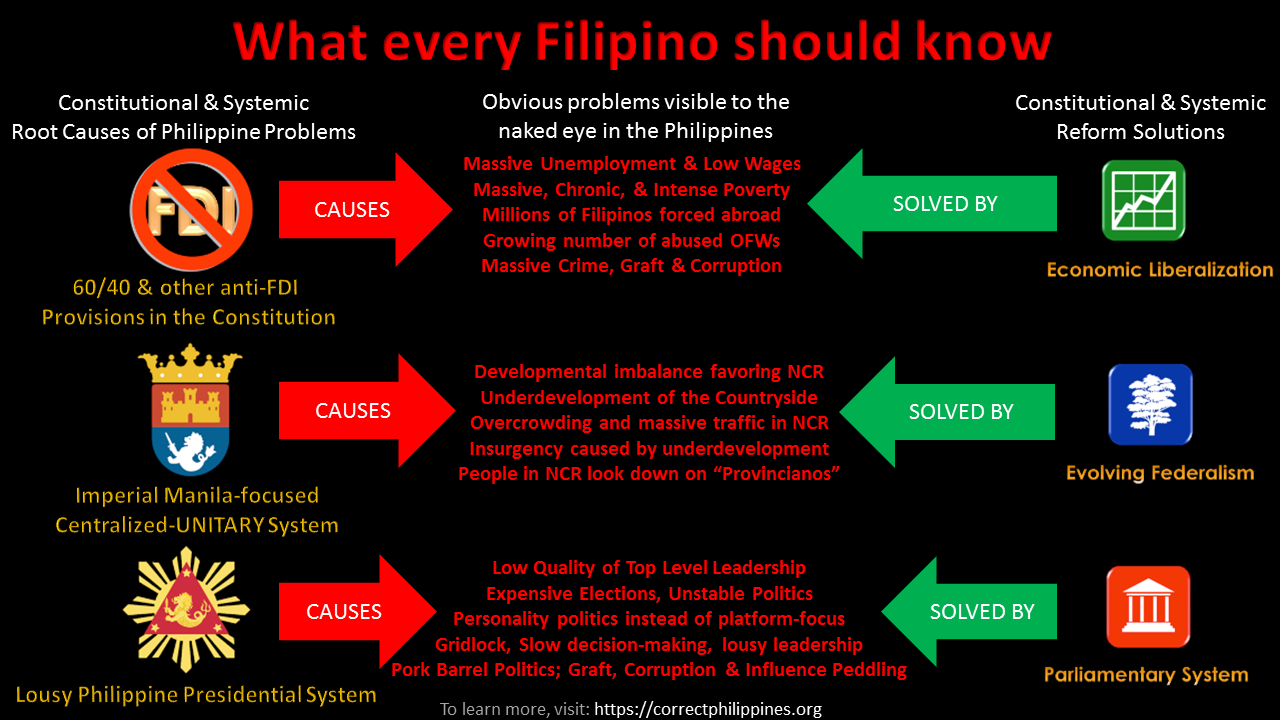
These flaws unfortunately contribute to all the major problems we continue to encounter in our daily lives as Filipinos. Massive Poverty, Massive Unemployment, Corruption, Rampant Criminality, Separatist Insurgency, Communist Trouble-making, Political Instability, Overcrowding in Metro Manila, Massive Traffic Jams, Pollution, the “drug mule” problem, dislocation from families among OFW’s, the Pork Barrel Scam, you name it — all these are symptoms of the systemic root problems caused by the flaws of the 1987 Constitution.
The CoRRECT™ Movement pushes for these main Three Constitutional Reforms:

Economic Liberalization
Dismantle Protectionism. Attract investors. Create more jobs.
If we are looking to increase the employment situation in the Philippines, then we must attract as many investors as possible by removing the restrictive provisions in the 1987 Constitution, so that MNC’s can invest & create employment opportunities.

Empower the regions, respect diversity, decongest Manila.
If we can amend the Constitution to allow for the Philippines to evolve towards Federalism, through gradual region-based decentralization, the regions & provinces of the Philippines can develop economically & the Capital can be decongested.

Platforms & Competence: True leadership, not popularity politics.
If we shift from our faulty and unstable Presidentialism over to Parliamentarism, we will gradually see a change in our politics as campaigns will focus more on parties and their platforms and less on name-recall & the personal popularity of candidates.
SECTION 1. There should be a President of the Philippines who will be the head of state and shall enable to perform such powers and functions mandated by this Constitution. SECTION 2. No person...
PREAMBLE We, the sovereign Filipino people, imploring the aid of Almighty God, in order to build a just and humane society, and establish a Government that shall embody our ideals and aspirations, promote the...
PREAMBLE We, the sovereign Filipino people, imploring the aid of Almighty God, in order to establish a Government that shall embody our ideals, promote the general welfare, conserve and develop our patrimony, and secure...
ARTICLE XIV EDUCATION, SCIENCE AND TECHNOLOGY, ARTS, CULTURE AND SPORTS Section 1. The State shall protect and promote the right of all citizens to quality education at all levels and shall take appropriate steps...
Section 1. The President shall be the Head of the State and the Commander-in-Chief of all the Armed Forces of the Philippines. Section 2. No person shall be elected as President unless he is natural-born...
Empower the regions decongest Manila. It is best yet for me the very best solution is develop every region base on its natural products available and the skills of the people. Further eradicate Salary...
Attract Investor, create more jobs. Philippines is the most strategic country in Asia Pacific region than Singapore. First we should adopt some laws of Singapore like eliminating travel tax, visa requirements (no visa to...
With automobile crashes together with other regrettable events getting a standard event, it might be higher time for you to know how a car accident law firm in addition to a personal injury law...
Originally posted at http://josephonperspectives.wordpress.com/2012/07/18/remove-the-6040-equity-limitations-against-foreign-investments/ At this point, talk about constitutional amendments on certain provisions especially the economic ones of the 1987 Constitution has resurfaced once again as Juan Ponce Enrile suggested to amend the...
Yes. Stop calling for Cha-cha! Stop calling for a Latin dance that goes forward & backward and doesn’t really get anyhere. Stop calling for something that people do not associate with progress or anything...
Presented to the Senate Committee on Constitutional Amendments February 17, 2011 By Dr. Jose V. Abueva President of Kalayaan College & Director of its Institute for a Federal Republic with a Parliamentary Government,...
It does not mean that foreign (especially multinational) companies will annex parts of our territory, claiming it in the name of their home countries or as themselves. It does not mean that with...
We found this open letter floating around in Facebook and have decided to OPEN LETTER FROM A SURVIVOR : After being stuck in a dead zone with no comms and internet the past 48...
This is the infamous video of the meeting where Mar Roxas tells Alfred Romualdez: “You have to understand you are a Romualdez and the President is an Aquino so <cut video> …so we just want to...
Posted on July 6, 2026
AFTER the recent revelations of the PORK BARREL SCAM, the PATRONAGE POLITICS EXPOSED during the Typhoon Yolanda Tragedy and the PRIVILEGED SPEECH REVELATIONS in SENATE, it strikes me that the GOVERNMENT OF THE PHILIPPINES...
Trial Originally entitled “The Philippines and Venezuela: Smartmatic and Carter Center but without the MUD (the Venezuelan Opposition)” By: Rómulo Lares Sánchez · Published on 10/12/2011 – See more at: http://www.frentepatriotico.com/inicio/2011/12/10/filipinas-y-venezuela-smartmatic-y-el-centro-carter-pero-sin-la-mud/#sthash.smJlmUhu.dpuf The ex-president of the Philippines (Gloria Macapagal-Arroyo) was...
Overview We all know that media piracy is a sin against the Seventh Commandment by violating intellectual property license agreements and never giving compensation to the copyright owners for use of media licenses. We...
From page 66 of LKY’s book “From Third World to First” —“We did not have a large group of ready-made entrepreneurs such as Hong Kong gained in the Chinese industrialists and bankers who came...
One major problem I find in the Philippines is that leaders, politicians, and even many “public intellectuals” – writers, columnists, professors, activists – haven’t quite learned to prioritize based on what are the ordinary...
Ever since Rodrigo Duterte won and announced that he was aggressively supporting constitutional reforms that would lead to the removal of anti-FDI restrictions as well as a shift to the Listening to the supporters...
Posted on July 6, 2026
Democracy: Presidential or Parliamentary Does it Make a Difference? Juan J. Linz Pelatiah Pert Professor of Political and Social Sciences Yale University July 1985 Paper prepared for the project, “The Role of Political Parties...
Some Americans are angry about the Electoral College, saying that the USA ought to get rid of it and only count the popular vote. Guess what, the Electoral College, as imperfect as it...
The Aussie Law YouTube site is operated by Renato Saeger M. Costa, a PhD in Law student at the University of Queensland. He’s originally from Brazil, but is an immigrant to Australia and occasionally...
The Forum of Federations is an international organization based in Ottawa, Canada. The Forum and its partners comprise a global network on Federalism. It brings together elected officials, civil servants and experts in federalism from...
(Originally entitled “Mr. John Gokongwei on Charter Change”) by Ducky Paredes (article from August of 2006) Mr. John, as his corporate family fondly refers to John Gokongwei, has always been known for being a...
Several Filipino politicians have recently said that the Philippine Government should not talk at all about Constitutional Reform and should – according to them – focus purely on the COVID-19 pandemic and crisis. But...
It’s about time the Philippines and all Filipinos started thinking straight regarding the Sabah issue and understanding that the most important part of the Sabah issue is what the People of Sabah themselves think...
Many of the anti-reform naysayers who do not have an evil vested interest in maintaining the status quo tend to go against procedural systemic reforms such as shifting from the Presidential System...
The late founding Prime Minister of Singapore, Lee Kuan Yew, had been invited by the Philippine Business Conference to address them back on November 18, 1992, not long after he had already stepped down...
by Dr. Jan Erk Dr. Jan Erk previously taught political science at Leiden University until September 2016. Prior to his departure, Jan Erk published his MOOC ‘Federalism and Decentralization: Evaluating Africa’s Track Record’. Currently,...
by the late Dr. Juan J. Linz As more of the world’s nations turn to democracy, interest in alternative constitutional forms and arrangements has expanded well beyond academic circles. In countries as dissimilar as...
ECONOMIC LIBERALIZATION 1. Ano ang ibig sabihin ng pag-alis sa probisyong 60/40 sa ating Saligang Batas ng 1987? Ito ay ang pagbura ng Article 12 Sections 9 to 11 at iba pang mga probisyon...
The Federal-Parliamentary System is Preferable to a Federal-Presidential System: Sticking to the Presidential System may worsen Philippine Politics (This article came out of the book “Quest for a Federal Republic: The PDP-Laban Model of...
by Juan J. Linz (July 1985) INTRODUCTION In recent decades renewed efforts have been made to study and understand the variety of political democracies, but most of those analyses have focused on the patterns of political conflict...
(Lecture given by Dr. Negasso Gidada, Former President of the FDRE, for a group from University of Maryland as part of UMD Study Abroad- Ethiopia 2015: University of Maryland Program in Ethiopia: The Policy and Politics of...
by Geoffrey de Q. Walker (Professor Emeritus from the University of Queensland) (This article was originally taken from the Parliament of Australia website) The new `age of federalism’ Worldwide interest in federalism is probably stronger...
[yd_list_posts]
Every single time there are Filipinos who go against Constitutional Reform, it’s always a matter of ignorance and wrong facts.
The people who are against these reforms simply do not understand it. Their knowledge about the current system is so flawed that they think that the current system is ok. They have very little understanding of what a true functioning system ought to be like, and as a result, they make the mistake of assuming that the system in the Philippines is ok.
Worse, their understanding of the reforms being pushed is also extremely substandard. They don’t know how economics works and don’t understand that by being more open to Foreign Direct Investors by removing the anti-FDI restrictions and 60/40 clauses in the Constitution actually goes a long way in attracting more investors to come in. They go against what they do not understand. Then there’s their lack of understanding of what Federalism is or how it works. They often fail to realize that some of the countries they admire the most such as the USA, or others like Australia, Austria, Belgium, Canada, Germany, and Switzerland happen to use Federalism.
And then there’s their utter ignorance about the Parliamentary System. They don’t know what it is or how it works, and oftentimes, they mistakenly think that the late Ferdinand Marcos’ Martial Law system was a Parliamentary System, when actually, we never had a functioning parliamentary system under Ferdinand Marcos during Martial Law, and afterwards, when it was lifted and Cesar Virata who was Finance Minister was made Prime Minister, that still wasn’t a parliamentary system as it was actually more like a Peruvian-style Presidential System, appearing Semi-Presidential like the French, but with the President fully in control, and the Prime Minister acting purely as an underling of the president.
Ultimately, the biggest problem is a lack of knowledge.
This website seeks to cure that problem by providing all the relevant information and knowledge so that more and more Filipinos can be informed and enlightened about what these reforms are and why we desperately need them.
The Philippines Must Learn from Singapore
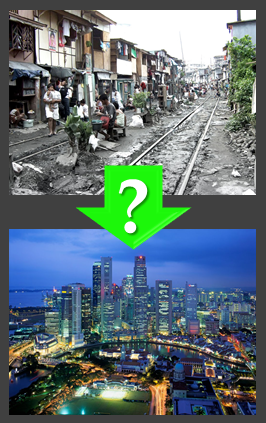
Singapore used to be much poorer and less developed than the Philippines back in the 1950s and 1960s, but as a result of policies designed to make Singapore much more open to foreign direct investors & multinational corporations, S’pore attracted more companies to come in. More jobs were created and unemployment & poverty were drastically reduced. As a result, S’pore became the richest in Asia. On the other hand, the Philippines with its highly restrictive anti-foreign investor restrictions in the 1987 Constitution, continues to turn investors off, making jobs scarce – keeping most Filipinos poor & desperate.
Singapore serves as a perfect example as the Philippines can easily learn to be open to foreign direct investors and multinational corporations in order to create more jobs. In the interest of political stability, the Philippines can also learn from how Singapore’s parliamentary system firstly allowed it to be able to end up with competent leaders like founding father Lee Kuan Yew and his People’s Action Party and see how it tends to be much more stable, efficient, and less prone to corruption. Lastly, because the Philippines is much bigger than Singapore, emulating Singapore requires that the Philippines autonomize its regions so that the regions all act each like Singapore and together attract investments and improve their own economies.
It’s also worth noting that Malaysia – whose majority Malays & Bumiputras are culturally similar to Filipinos – took many key learnings and insights from Singapore too. As a result, Malaysia is also one of the ASEAN region’s better economies. It’s time to quit being Asia’s Basketcase of Wasted Democrazy! [fikraticker]